
About Bent's Old Fort
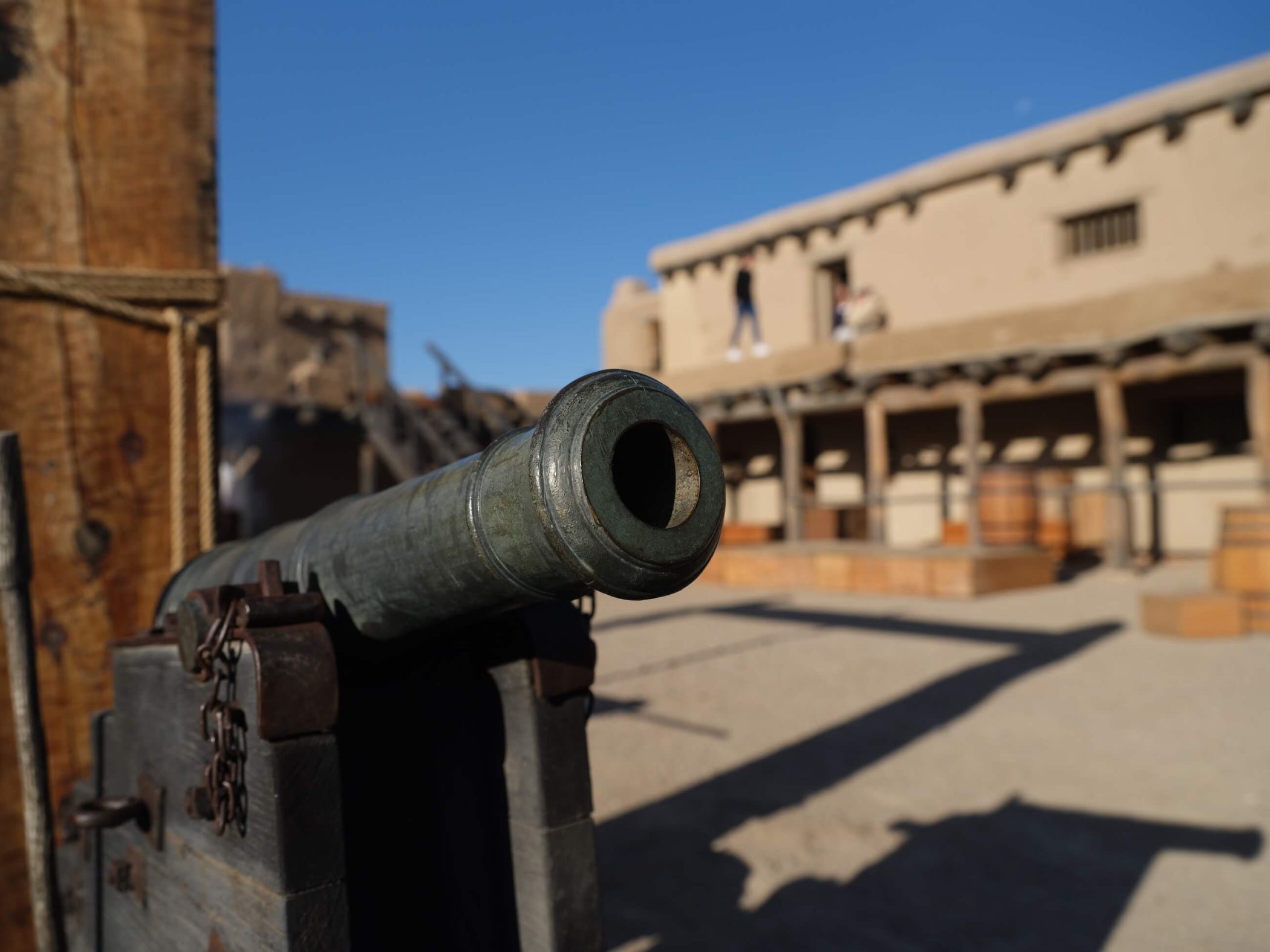
Bent’s Old Fort National Historic Site is located just 7 miles from La Junta and over 150 years back in time. This reconstructed trading post located on the Santa Fe Trail was the last United States outpost before crossing the Arkansas River and entering Mexico.
The Fort was originally built in 1833-34 by brothers Charles and William Bent and Ceran St. Vrain for the Native American fur trade and served as an important stop along the Santa Fe Trail. Today, a reconstructed fort allows visitors to explore the front line of Westward Expansion.



History of Bent's Old Fort
Bent’s Old Fort National Historic Site, straddles both banks of the Arkansas River. For most of the first half of the nineteenth century, the river served as a boundary between Mexico and lands claimed by the United States. It was known to the Spanish and the Utes as the Rió Nepesta and the Cheyenne and Arapaho as Mó'soonêó'he'e. The landscape around the river was once home to vast herds of buffalo and it continues to host a wide range of wildlife that call the short grass prairie of the high plains home. Seasonal migrations of sandhill cranes, snow geese and others fill the skies, along with red-winged blackbirds, hawks, bald and golden eagles, magpies, and turkeys. Deer, elk, pronghorn, prairie dogs, coyotes, mountain lions, bobcats, badgers, porcupines, and many other species live here.
This natural environment attracted the first human inhabitants. Fourteen affiliated tribes consider the area part of their ancestral homelands. They and their predecessors lived here for thousands of years before the first Europeans arrived. With Spanish exploration and colonization of New Mexico, the area witnessed Spanish incursions and the reintroduction of the horse after the Pueblo Revolt of 1680. The return of the horse would revolutionize the lives of the Native American people here. As a result, this region became the heart of an extensive western Comanche trade center with French, German, and Spanish traders documented in the area as early as 1749. After the Louisiana Purchase, the river served as a closed international boundary between the United States and New Spain.
The future site of Bent’s Old Fort witnessed several United States government exploratory expeditions to the region including the Zebulon Pike Expedition of 1806-07 and the Stephen Long Expedition of 1820. John C. Fremont stopped over at the fort during his second, third, and fourth expeditions during the 1840s and passed by the abandoned fort during his fifth and final expedition in 1853-54.
Mexico’s hard-fought independence from Spain in 1821 opened the international border allowing trade with the United States. The resulting economic boom along the Santa Fe Trail resulted in vastly increased traffic through the region. It brought other newcomers such as Charles and William Bent and their partner Ceran St. Vrain. They soon formed a trading partnership with the Cheyenne and Arapaho, cemented by William Bent’s marriage to Owl Woman. This business and cultural alliance resulted in the construction of Bent’s Old Fort by Nuevomexicano adobe workers from the Rió Grande Valley to take advantage of the rapidly increasing buffalo robe trade with the tribes.
From 1833 – 1849 Bent’s Old Fort was the most important commercial hub on the Southern Plains in U.S. territory. Trade and influence radiated from here south into Texas and Mexico, west into the Great Basin, north into what is now southern Wyoming and to markets in the eastern U.S. For a time, Bent's Old Fort was the only structure on the Santa Fe Trail in U.S. territory between modern day Kansas City and Santa Fe, which was at that time part of Mexico.
U.S. Westward Expansion led to the fort’s use as a forward observation post, supply depot, and launch point for the U.S. invasion of New Mexico during the U.S./Mexican War in 1846. War brought chaos to the area through combat, spread of disease, and increased traffic along the Santa Fé Trail, leading to a decrease in limited natural resources and resulting conflict with some of the tribes. Charles Bent became the figurehead of the U.S. invasion when he was appointed the first U.S. Governor of New Mexico Territory. His assassination during the Taos Revolt in 1847, the brutal defeat of the revolt by the army, followed by reprisals, tribunals, and executions caused hard feelings towards the company by Nuevomexicanos. These factors, in addition to the death of Owl Woman later that year, led to the dissolution of Bent, St. Vrain, and Company, and ultimately the abandonment of Bent’s Old Fort in 1849. William Bent later supervised the construction of Bent’s New Fort further east in 1853.
Bent’s Old Fort would be reoccupied following the mass incursion of miners during the Pike’s Peak Gold Rush of 1859. In 1860, it would begin use as a stagecoach station and a post office soon after. Col. Chivington’s troops passed by on their way to execute the Sand Creek Massacre in 1864. Some of William Bent’s children were present at the massacre; however, they survived the attack and William served as a U.S. Commissioner to negotiate a new treaty with the Cheyenne and Arapaho in 1865. Arrival of the railroad and creation of La Junta in 1876 ended the need for the stage line along this route; however, the structure continued to be used by ranchers into the twentieth century. By then, all the Native American people who had once lived and traded here had been forcibly removed to reservations by the U.S. government, most of them far away from this land.
The Daughters of the American Revolution (DAR) first sought to preserve the site due to its national significance and relationship to the Santa Fé Trail. After a generation of stewardship, the DAR sold the site to the State of Colorado in 1953. Like the DAR before them, the state was unable to achieve the desired goal of reconstructing the fort. As part of a movement to recognize and preserve nationally significant sites associated with Westward Expansion, the United States Congress authorized Bent’s Old Fort as a unit of the National Park System in 1960. Management of the site was assumed by the National Park Service in 1963.
Constructed between 1975-1976 and dedicated in July 1976, the reconstruction of Bent’s Old Fort is the largest monument to the United States Bicentennial built in Colorado. For more than a century, Bent’s Old Fort has served as a place where Americans remember and interact with our collective past and continue to “commemorate the historic role played by such fort in the opening of the West.”